
As we step into a new year, many of us reflect on habits we would like to change or improve. For desk-based professionals, posture is often one of those quiet, ongoing challenges, particularly when long hours at a screen are part of everyday life.
Over the past weeks, we have been discussing text neck and forward head posture: a postural pattern in which the head gradually shifts forward in relation to the shoulders and torso. This change alters the mechanical load on the cervical spine. Over time, it can increase strain on the neck, shoulders, and upper back and may contribute to pain, stiffness, headaches, and reduced mobility.
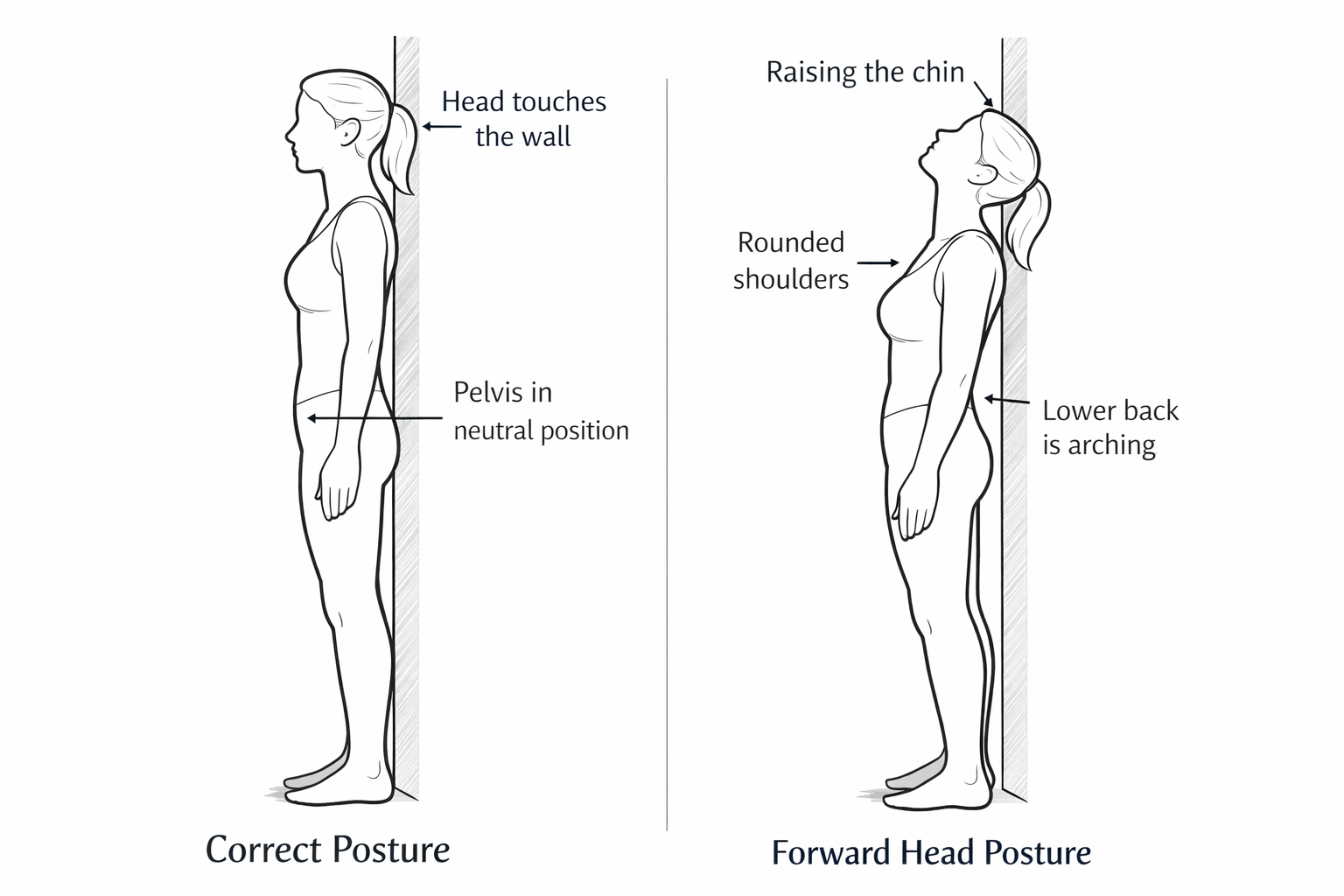
I would like to share a simple posture check that can give you an indication of your head position in relation to the rest of your body.
1. Stand with your back against a wall.
2. Allow your heels, pelvis, upper back (thoracic spine), and head to rest against the wall.
3. Keep your gaze forward and your chin parallel to the floor.
4. Notice how your head relates to the wall without forcing or adjusting the position.
If the back of your head can comfortably make contact with the wall while the chin remains parallel to the floor, this suggests a more neutral alignment of the cervical spine. In this position, the head is balanced more directly over the torso, and the load on the neck muscles and spinal structures is more evenly distributed.
If contact with the wall is only possible by lifting the chin upwards, this often indicates forward head posture. In this pattern, the head sits anterior to the shoulders, increasing the mechanical load on the cervical spine. To keep the eyes level and the head upright, the body often compensates through increased muscle activity in the upper back, shoulders, and neck, which can contribute to tension, fatigue, discomfort and pain.
This brief check is not intended to diagnose or correct posture. Its purpose is to increase your awareness of habitual alignment.
Leave A Comment
You must be logged in to post a comment.